How to Create a Weekly Meal Plan You Will Actually Follow
A weekly meal plan should make your life easier. It should not feel like another strict schedule that you have to follow perfectly.
Many meal plans fail because they are created for an ideal week. They assume that you will have time to cook every evening, feel excited about every recipe, remember to defrost ingredients and never receive an unexpected invitation. Real life rarely works that way.
I recommend building your meal plan around the week you are actually going to have. That means looking at your schedule, choosing foods you genuinely enjoy, keeping difficult meals away from busy days and leaving some room for plans to change.
A realistic weekly meal plan usually does four things well:
It covers the meals that require a decision.
It matches the time and energy available each day.
It uses ingredients efficiently.
It includes an alternative for days when the original plan does not work.
You do not need seven completely different dinners, several hours of meal prep or a perfectly balanced menu every day. You need a simple system that helps you decide what to eat before you become tired, hungry or rushed.
What is a weekly meal plan?
A weekly meal plan is a written outline of the meals you expect to eat during the coming week. It may include every breakfast, lunch, dinner and snack, but it does not have to.
For many people, planning only dinners is enough. Breakfast and lunch may already follow a predictable pattern. Someone might eat oatmeal or eggs most mornings and take leftovers or sandwiches for lunch. In that situation, planning seven detailed breakfasts would create work without solving a real problem.
Meal planning is also different from meal prep.
Meal planning means deciding what you expect to eat. Meal prep means doing some of the cooking or preparation in advance. You can plan meals without preparing them early, and you can prepare only the parts that usually slow you down.
Research involving more than 40,000 adults found that meal planning was associated with greater food variety and better adherence to nutrition guidelines. However, the study was observational, so it cannot prove that meal planning caused those differences. (PubMed Central (PMC))
The practical benefit is easier to see. When you already know what you can make, you remove one decision from a busy part of the day.
Start with your real schedule
Do not begin by browsing recipes.
Begin with your calendar.
Look at work, school, appointments, exercise, travel, social plans and any evening when you may arrive home later than usual. Then consider how much time and energy you are likely to have on each day.
A meal that works well on Sunday afternoon may be completely unrealistic on Wednesday after a long workday. The recipe is not the problem. Its position in the week is.
I find it helpful to classify each day by cooking capacity.
| Type of day | What the day looks like | Suitable meal |
|---|---|---|
| Higher-energy day | More free time and fewer commitments | A new recipe, roasting, batch cooking or a meal with several parts |
| Normal day | Some time to cook, but not all evening | A familiar 20 to 30 minute meal |
| Low-energy day | Late work, appointments, travel or exhaustion | Leftovers, a freezer meal, sandwiches, eggs, soup or a simple assembled meal |
| Uncertain day | Plans may change | A flexible meal that uses shelf-stable, refrigerated or frozen ingredients |
This small step prevents one of the most common meal-planning mistakes: assigning the most demanding recipe to the busiest night.
Work out how many meals you actually need
A seven-day week does not automatically require seven cooked dinners.
Before choosing meals, subtract the evenings that are already covered.
For example:
One evening may involve eating at a restaurant.
One evening may use leftovers.
One evening may be uncertain.
One evening may use a freezer meal.
One evening may be a regular family takeaway night.
That leaves only three dinners that need new decisions.
- Suppose your week looks like this:
- 7 evenings
- 1 restaurant meal
- 1 leftover night
- 1 flexible night
- 1 freezer meal
- = 3 planned cooked dinners
Planning three realistic dinners is better than buying ingredients for seven meals and abandoning half of them.
For your first few weeks, I recommend planning fewer meals than you think you can manage. Harvard’s Nutrition Source also recommends starting small, such as preparing enough dinners for two or three days, instead of trying to transform the entire week at once. (The Nutrition Source)
You can add more structure when the smaller plan begins to feel easy.
Check what you already have
Once you understand your week, check your refrigerator, freezer and pantry.
- Look for:
- Fresh foods that need to be used soon
- Open packages
- Leftover ingredients from the previous week
- Frozen meals or proteins
- Grains, pasta and canned foods
- Sauces, herbs and seasonings
- Foods you bought but forgot to use
Start your plan with the ingredients most likely to spoil.
If you already have spinach, eggs, potatoes and half a block of cheese, you could plan an omelet, frittata or baked potato meal before buying ingredients for something completely different.
This does more than reduce waste. It also makes the grocery list shorter and gives you a clear place to start.
Safefood and MyPlate both recommend checking available ingredients, planning around foods that need to be used and making leftovers part of the weekly plan. (Safefood)
Choose familiar meals before new recipes
A practical meal plan should contain more familiar meals than experiments.
New recipes require extra attention. You need to read the method, find unfamiliar ingredients, estimate preparation time and learn how the dish behaves while cooking. That may be enjoyable when you have enough time, but it becomes stressful on a busy evening.
- A useful starting pattern is:
- Two or three familiar meals
- One especially easy meal
- One new recipe, if you want one
- One leftover meal
- One flexible or backup meal
This is not a rule. It is a starting point that keeps the plan interesting without turning every evening into a cooking project.
Create a personal list of dependable meals that you already know how to make. You might include pasta with vegetables, chicken and rice, lentil curry, tacos, baked potatoes, omelets, soup, sandwiches or a simple stir-fry.
Your list does not need to impress anyone. It needs to help you eat on a normal Tuesday.
Plan meals you genuinely want to eat
A nutritious meal will not help much if you repeatedly avoid it and order something else.
Include foods, flavors and textures that you enjoy. A weekly meal plan should not be built as a punishment for what you ate last week.
- Ask yourself:
- Would I still want this meal after a tiring day?
- Does everyone eating it like at least part of it?
- Have I made it before?
- Can I adjust it if my appetite changes?
- Does it fit the weather and season?
- Will the ingredients still be usable when I plan to cook it?
You do not need to choose only your favorite comfort foods, but every planned meal should have something that makes it satisfying.
That might be a sauce you enjoy, warm bread, a crunchy topping, roasted vegetables, a familiar spice mixture or a side dish that makes the meal feel complete.
Use a simple structure for balanced meals
You do not have to calculate every nutrient before putting a meal on your calendar.
| For most general meal planning, I use four basic parts: | A source of protein | A carbohydrate or starchy food |
|---|---|---|
| A fruit or vegetable | A source of fat, sauce or flavor | For example: |
| Protein | Carbohydrate | Produce |
| Fat or flavor | Chicken | Rice |
| Broccoli | Yogurt and herb sauce | Beans |
| Tortilla | Peppers and tomato | Avocado |
| Eggs | Whole-grain toast | Mushrooms and fruit |
| Cheese | Salmon | Potatoes |
| Green beans | Olive oil and lemon | Lentils |
| Flatbread | Cucumber salad | Tahini sauce |
Not every meal needs four separate items. A curry, soup, sandwich, pasta dish or casserole may contain several parts in one recipe.
The Academy of Nutrition and Dietetics recommends considering whether a meal contains protein, carbohydrate, fat and fiber, while also emphasizing that nutrition needs are supported by eating patterns over time rather than one perfect meal. (Eat Right)
This matters because an overly strict plan can become harder to follow. Your meals do not have to look nutritionally identical every day.
Match each meal to your available energy
Cooking time is only part of the difficulty.
A recipe may claim to take 25 minutes, but it can still require chopping, several pans, close attention and a kitchen cleanup. On an exhausting day, that may be too much.
Think about the total effort.
| Higher-effort meals | These may involve: | A new recipe |
|---|---|---|
| Several cooking methods | Longer chopping | Multiple pans |
| Dough or baking | Ingredients that need careful timing | |
Place these meals on days when you have more time.
Medium-effort meals
These usually include familiar meals that take 20 to 30 minutes and use one or two main cooking methods.
Examples include pasta, stir-fries, tacos, curries using prepared ingredients and sheet-pan meals.
Low-effort meals
These are the meals that protect your plan when energy is low.
- Examples include:
- Eggs and toast
- Soup and a sandwich
- A frozen meal with vegetables
- Rotisserie chicken with bread and salad
- Beans on toast
- Yogurt, fruit and cereal
- A tuna wrap
- Leftovers
- A simple rice or grain bowl
Convenience does not automatically make a meal unsuitable. A realistic plan may include frozen vegetables, canned beans, prepared sauces, chopped produce, cooked grains and other foods that reduce the work required.
The best level of convenience depends on your budget, cooking ability and available time.
Repeat ingredients without repeating every meal
Ingredient overlap can reduce cost, shopping time and food waste.
This does not mean eating the same complete meal every day. It means choosing recipes that share some main ingredients.
- For example, one week might use:
- Chicken in a rice bowl
- Chicken in wraps
- Peppers in both meals
- Yogurt in a sauce and at breakfast
- Spinach in an omelet and pasta
- Rice with a curry and later in a fried rice meal
Safefood recommends choosing recipes that use the same key ingredients and selecting a few vegetables that can work across several meals. (Safefood)
Try to reuse expensive or perishable foods first. Fresh herbs, salad leaves, specialty cheeses and large packages of meat are more likely to be wasted when they appear in only one recipe.
Dry spices do not need the same level of attention because they last much longer.
Give leftovers a specific job
Writing “leftovers” on the plan is not enough if you do not know which leftovers you expect to have.
Decide which meal will produce them and when you will use them.
For example:
Monday chicken becomes Tuesday lunch.
Tuesday curry becomes Thursday dinner.
Wednesday roasted vegetables go into Thursday wraps.
Extra rice becomes Friday fried rice.
Sunday soup is frozen for a future low-energy evening.
Purposeful leftovers are easier to use than random containers that disappear into the back of the refrigerator.
FoodSafety.gov advises keeping many cooked leftovers, including cooked meat, poultry, soups and stews, for about three to four days in a refrigerator kept at 40°F, or 4°C, or below. Storage recommendations differ by food, so check specific guidance when you are uncertain. (FoodSafety.gov)
Freeze portions that you will not use safely within the recommended refrigerator period.
Leave room for the week to change
A plan becomes difficult to follow when every meal is tied to one exact day.
Instead of treating your calendar as a strict set of instructions, think of it as a short menu for the week.
Some meals need a fixed day because ingredients are highly perishable or because you have more cooking time. Other meals can move.
- For example:
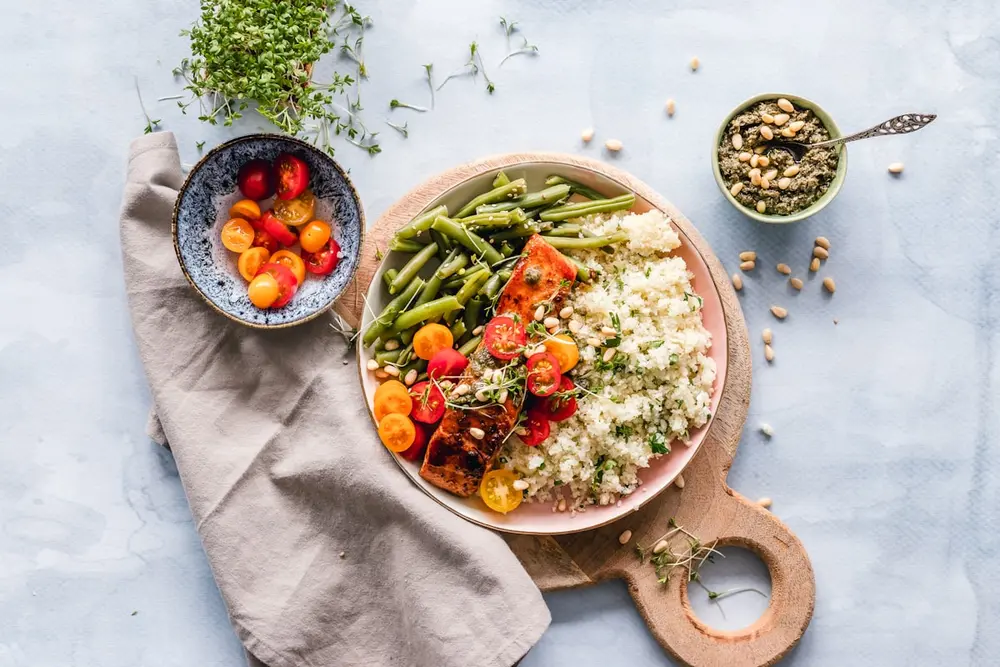
- Monday: Salmon, potatoes and green beans
- Tuesday: Chicken wraps
- Wednesday: Leftovers
- Thursday: Lentil curry
- Friday: Flexible meal
- Saturday: Pasta with vegetables
- Sunday: Eat out
If Tuesday becomes busy, you can move the wraps to Thursday and eat leftovers earlier. The ingredients still have a purpose, and the week does not feel ruined.
| I recommend including at least one flexible meal. This might be: | A freezer meal | Pasta with a jarred sauce |
|---|---|---|
| Eggs | Soup | Sandwiches |
| Beans and rice | A meal made from leftovers | A planned takeaway |
| A restaurant meal | ||
The backup should be easier than the original meal. A backup that requires another complicated recipe is not a useful backup.
Create the grocery list from the finished plan
Do not begin with a general list of foods that sound healthy.
Build your grocery list from the meals you selected.
For each meal, check the recipe or write down the ingredients you normally use. Combine repeated ingredients, estimate the total quantity and remove anything you already have.
Then add foods for breakfasts, lunches and snacks that are not covered by planned leftovers.
- Organize the list according to the way you shop:
- Produce
- Meat, fish and other proteins
- Dairy and refrigerated foods
- Grains and bakery
- Canned and packaged foods
- Frozen foods
- Household items
The Academy of Nutrition and Dietetics recommends creating a grocery list from selected meals and organizing it around the store layout. A list can also help limit unplanned purchases and foods that may go unused. (Eat Right)
Before shopping, check your kitchen one more time. It is easy to add rice, oil, onions or spices to a list without noticing that you already have enough.
Prepare only what will make the week easier
Meal prep does not have to mean cooking every meal on Sunday and storing seven identical containers.
Prepare the parts that usually delay you.
- This might include:
- Washing and chopping vegetables
- Cooking rice or another grain
- Making one sauce
- Marinating a protein
- Cooking a pot of beans
- Boiling eggs
- Portioning snacks
- Defrosting tomorrow’s ingredients
- Cooking one large meal for leftovers
Harvard’s Nutrition Source suggests separating menu planning, grocery shopping and meal preparation when doing everything on one day feels overwhelming. It also recommends starting with foods that take longer to cook and preparing versatile staples that can be added to several meals. (The Nutrition Source)
Choose the amount of preparation that removes friction without using all your free time.
Put the plan where you can see it
A meal plan hidden in a notebook or forgotten application cannot guide your week.
Keep it somewhere visible and easy to update.
- You could use:
- A note on the refrigerator
- A paper planner
- A shared family calendar
- A phone note
- A spreadsheet
- A meal-planning application
Add any action that must happen before the meal.
For example:
Tuesday evening: Move chicken from freezer to refrigerator.
Wednesday morning: Put ingredients in slow cooker.
Thursday evening: Cook extra rice for Friday.
These small reminders often matter more than the name of the meal itself.
A realistic weekly meal plan example
Here is an example for one adult or couple with a busy working week.
| Day | Schedule | Dinner | Preparation note |
|---|---|---|---|
| Monday | Normal evening | Chicken, rice and roasted vegetables | Cook extra chicken and rice |
| Tuesday | Late appointment | Chicken wraps with salad | Use Monday’s chicken |
| Wednesday | Normal evening | Lentil curry | Make enough for Thursday |
| Thursday | Very busy | Leftover lentil curry | Reheat and add yogurt |
| Friday | Uncertain plans | Flexible meal | Use freezer meal or eat out |
| Saturday | More time | Homemade pasta with vegetables | Try one new recipe |
| Sunday | Planning and shopping day | Omelet, toast and fruit | Use remaining vegetables |
The plan contains only four main cooking sessions. It uses leftovers intentionally, includes one flexible evening and puts the new recipe on the day with the most time.
That is more realistic than planning seven unrelated recipes.
What to do when you do not feel like eating the planned meal
You are allowed to change your mind.
Before abandoning the plan completely, ask what you dislike about the meal at that moment.
You may not want the flavor, the effort, the temperature or the amount of food.
A small adjustment may solve the problem.
For example:
Turn planned chicken and rice into a wrap.
Use vegetables in an omelet instead of a stir-fry.
Serve a planned hot protein in a cold salad.
Move tonight’s meal to another day.
Freeze ingredients that will not remain safe.
Replace the meal with your backup option.
The goal is not perfect obedience. The goal is to keep the food useful and make a reasonable decision.
- Common reasons weekly meal plans fail
- Planning too many meals
Buying ingredients for every possible breakfast, lunch and dinner can create more food than you can realistically prepare.
Start with the meals that cause the most stress.
Choosing too many new recipes
New recipes make a plan look exciting, but they also increase cost, preparation and uncertainty.
Keep most meals familiar.
Ignoring the calendar
A meal plan that does not account for late work, appointments and social events is only a list of recipe ideas.
Match the meal to the day.
Making every meal a cooking project
Some evenings need assembled food, leftovers or convenient ingredients.
Easy meals are part of a successful system.
Forgetting about leftovers
Extra food needs a date and purpose. Decide when it will become lunch, dinner or a freezer portion.
Buying ingredients before finishing the plan
This often creates several foods that do not combine into complete meals.
Plan first, then shop.
Treating one change as failure
Moving a meal, ordering food or skipping a recipe does not destroy the week.
Adjust the remaining plan and continue.
Review the plan before creating the next one
A meal plan improves when you learn from it.
At the end of the week, spend a few minutes reviewing what happened.
- Ask yourself:
- Which meals did I look forward to?
- Which meal required too much effort?
- What ingredients remained unused?
- Did I plan too much or too little food?
- Which leftovers worked well?
- When did I order food unexpectedly?
- Which backup meal helped?
- What should I repeat next week?
Keep successful meals on your dependable-meals list.
Remove recipes that looked good but did not fit your routine. You do not have to keep planning a meal simply because it appears healthy or popular.
The purpose of the review is not to judge yourself. It is to make the next plan more accurate.
How do you know whether your meal plan is working?
A successful plan is not one that you follow perfectly.
It is working when:
You spend less time wondering what to eat.
Most purchased food has a purpose.
The meals fit your schedule.
You have something available on difficult days.
You enjoy most of what you eat.
The plan supports your nutrition goals without controlling your whole week.
You can adjust it without feeling that you failed.
Following four planned dinners and using the remaining ingredients well may be more successful than completing seven meals while feeling exhausted.
Frequently asked questions
Do I need to plan every meal for the week?
No. Plan the meals that require decisions. If breakfast and lunch already follow a reliable routine, you may only need to plan dinners and a few snacks.
How many dinners should a beginner plan?
Start with two to four dinners, depending on your schedule. Include leftovers, eating out and easy backup meals before deciding how many recipes you need.
Is it acceptable to eat the same meal more than once?
Yes. Repeating a breakfast, lunch or dinner can reduce preparation and shopping work. Try to include variety across the wider week rather than forcing every meal to be different.
Should I assign every meal to a specific day?
Assign perishable foods and demanding recipes to suitable days. Less perishable and easier meals can remain flexible so you can move them when plans change.
How can I plan meals around calories or macros?
Start with your daily target, then decide how you prefer to distribute food across meals and snacks. Choose portions that fit those approximate meal targets. You do not need every day to match perfectly, but medically prescribed targets may require help from a registered dietitian.
What should I do when cooking for people with different preferences?
Build meals from adjustable parts. Tacos, bowls, pasta, wraps, baked potatoes and sandwiches allow each person to choose toppings or portions without requiring several completely different meals.
How long can I keep leftovers?
Many cooked leftovers can remain refrigerated for three to four days at 40°F, or 4°C, or below, but recommendations differ by food. Freeze food you will not use within its safe storage period. (FoodSafety.gov)
A simple meal plan is easier to follow
The most useful weekly meal plan is rarely the most detailed one.
Start with your calendar. Count how many meals genuinely need planning. Use foods you already have, choose familiar meals, match recipes to your available energy and leave at least one flexible space.
Then create your grocery list and prepare only the foods that will make the week easier.
Your plan will not always happen exactly as written. It does not need to. A good plan gives you direction while leaving enough room for real life.
This first article establishes the central NutritionPlanner.net philosophy: realistic planning, useful structure and flexibility without unnecessary restriction.