How to Spread Protein Evenly Throughout the Day
Spreading protein evenly does not mean eating exactly the same number of grams at every meal.
It means avoiding a pattern in which breakfast and lunch contain very little protein while dinner carries almost the entire daily amount.
A practical approach is to:
Estimate an appropriate daily protein target.
Count the meals and protein-rich snacks you normally eat.
Divide the target into workable meal ranges.
Strengthen the meals that currently contribute the least.
Review the daily total before adding supplements or extra food.
Suppose your daily target is 90 grams.
| A reasonably distributed day could contain: | Breakfast: | 25 grams |
|---|---|---|
| Lunch: | 30 grams | Dinner: |
| 35 grams | It could also contain: | Breakfast: |
| 20 grams | Lunch: | 25 grams |
| Snack: | 15 grams | Dinner: |
| 30 grams | ||
Both patterns provide 90 grams.
The meals do not need to match perfectly. What matters is that protein appears meaningfully across the day rather than almost entirely in one evening meal.
What does evenly distributed protein mean?
Researchers use several definitions of even distribution.
One study might compare three meals containing similar protein amounts. Another might measure how closely each meal approaches a body-weight-based target. A third might compare the percentage of daily protein eaten at breakfast, lunch, and dinner.
For ordinary meal planning, I use a simpler definition:
Each main meal should make a useful contribution to the daily protein target.
That usually means:
Breakfast is not limited to coffee and toast.
Lunch contains a clear protein source.
Dinner does not need to compensate for the whole day.
Snacks provide protein only when they serve a real purpose.
An even pattern might look like 25, 30, and 35 grams.
An uneven pattern might look like 6, 14, and 65 grams.
The first pattern is not mathematically equal, but it distributes protein more practically.
Why protein intake often becomes dinner-heavy
Many people naturally eat more protein at dinner.
- Breakfast may consist of:
- Toast
- Cereal
- Fruit
- Coffee
- A pastry
- A small oatmeal portion
- Lunch may consist of:
- A light salad
- Soup
- A small sandwich
- Snack foods
- Leftover side dishes
- Dinner is more likely to include:
- Chicken
- Fish
- Meat
- Tofu
- Beans
- Lentils
- Eggs
- Dairy
- Several protein foods together
- This creates a pattern such as:
- Eating occasion
- Protein
- Breakfast
- 7 g
- Lunch
- 15 g
- Dinner
- 48 g
- Daily total
- 70 g
The total may be appropriate, but the distribution is concentrated late in the day.
The easiest improvement is usually not adding more protein at dinner. It is moving or adding some protein earlier.
Daily protein still comes first
Protein timing cannot repair an inadequate daily total.
- Suppose someone needs approximately 90 grams but eats:
- Breakfast:
- 15 grams
- Lunch:
- 15 grams
- Dinner:
- 15 grams
The distribution is perfectly even, but the total is only 45 grams.
- Another person might eat:
- Breakfast:
- 20 grams
- Lunch:
- 25 grams
- Dinner:
- 45 grams
The distribution is less even, but the daily total reaches 90 grams.
Neither principle should be considered in isolation.
A 2024 review concluded that total daily protein appears to be the most important dietary factor for lean body mass. The importance of protein quality and meal distribution may become smaller when the daily amount is already sufficiently high.
- Use this order:
- Priority 1:
- Appropriate daily total
- Priority 2:
- Useful distribution across meals
- Priority 3:
- Timing around training when relevant
- Estimate your daily protein target
The adult Recommended Dietary Allowance is 0.8 grams of protein per kilogram of body weight per day. The RDA is intended to meet the needs of nearly all healthy adults in its reference group. It is not a muscle-building target or a universal maximum.
Use:
| Daily protein target = | body weight in kilograms |
|---|---|
| × selected grams per kilogram | To convert pounds into kilograms: |
| Body weight in kilograms = | body weight in pounds ÷ 2.205 |
| For a 70-kilogram adult: | At 0.8 g/kg: |
| 70 × 0.8 = 56 grams per day | For a more active person using 1.2 grams per kilogram: |
| 70 × 1.2 = 84 grams per day | For someone using 1.6 grams per kilogram: |
Athletes are often advised to consume approximately 1.2 to 2.0 grams per kilogram per day, depending on their training, energy intake, and goals.
These figures are planning references. They do not establish the correct target for every person.
Count your normal protein opportunities
Next, count the eating occasions that can realistically contain protein.
Possible patterns include:
| Three meals | Breakfast | Lunch | Dinner | Three meals and one snack |
|---|---|---|---|---|
| Breakfast | Lunch | Protein-rich snack | Dinner | Two large meals and one snack |
| First meal | Snack | Second meal | Four smaller meals | Meal 1 |
Do not create six eating occasions merely because frequent protein feeding appears in sports-nutrition discussions.
| Use the meal frequency that fits: | Your appetite | Work schedule |
|---|---|---|
| Training | Sleep | Culture |
| Medical needs | Personal preference | |
Distribution should fit your life rather than forcing your life to fit a protein timetable.
- Divide the daily target
- Use:
- Starting protein amount per eating occasion =
- daily protein target
- ÷ number of protein-containing eating occasions
- For 75 grams across three meals:
- 75 ÷ 3 = 25 grams per meal
- For 90 grams across three meals:
- 90 ÷ 3 = 30 grams per meal
- For 100 grams across four eating occasions:
- 100 ÷ 4 = 25 grams per eating occasion
- For 120 grams across four eating occasions:
- 120 ÷ 4 = 30 grams per eating occasion
This calculation gives you a starting point, not a strict instruction.
Use ranges rather than exact numbers
Exact equality is rarely necessary.
- For a target of 90 grams, a useful range might be:
- Eating occasion
- Planning range
- Breakfast
- 20 to 30 g
- Lunch
- 25 to 35 g
- Dinner
- 30 to 40 g
- Another person may prefer:
- Eating occasion
- Planning range
- Breakfast
- 20 to 25 g
- Lunch
- 25 to 30 g
- Snack
- 10 to 15 g
- Dinner
- 25 to 35 g
The daily result can still fall near 90 grams.
- Ranges allow for:
- Different recipes
- Changing appetite
- Restaurant meals
- Portion variation
- Foods with uncertain nutrition information
- Days with and without snacks
- You do not need mathematical equality
Consider these two 90-gram days.
| Day one | Breakfast: | 30 grams |
|---|---|---|
| Lunch: | 30 grams | Dinner: |
| 30 grams | Day two | Breakfast: |
| 24 grams | Lunch: | 29 grams |
| Dinner: | 37 grams | |
Both provide 90 grams.
The second day is still reasonably distributed.
Do not add another egg, yogurt, or shake simply to make each meal reach an identical number.
What does the research show?
One controlled study compared a pattern with moderate protein at breakfast, lunch, and dinner against a pattern containing little protein at breakfast, a moderate amount at lunch, and most protein at dinner.
The more even pattern produced a 25 percent higher 24-hour muscle protein synthesis rate during the short study.
That result supports the idea that spreading protein can improve the acute muscle-building response.
However, acute muscle protein synthesis is not the same as long-term muscle growth.
An eight-week randomized trial in older adults found no meaningful difference between even and uneven protein distribution in lean mass, strength, physical function, whole-body protein kinetics, or muscle protein synthesis when participants consumed the same total daily protein.
A 2024 study of women completing a weight-loss intervention also found no meaningful body-composition advantage from an even distribution compared with a more skewed pattern.
The most accurate conclusion is:
Even distribution can improve the short-term muscle protein synthesis response.
Total daily protein remains the more important foundation.
Long-term benefits from perfectly even distribution remain uncertain.
A reasonable distribution is useful, but exact equality is not required.
Why spreading protein may still help
Even without a guaranteed long-term muscle advantage, spreading protein can be practical.
It may help you:
- Reach a high daily target without an enormous dinner
- Build more substantial breakfasts and lunches
- Support meals around training
- Avoid depending on several supplements late in the day
- Create clearer portions
- Include more varied protein sources
These benefits are practical rather than promises of a specific health outcome.
Start by reviewing one normal day
Before changing anything, record one or two ordinary days.
- For each eating occasion, write:
- Food
- Portion
- Estimated protein
- Time
- Whether the meal felt sufficient
- For example:
- Eating occasion
- Food
- Protein
- Breakfast
- Toast and coffee
- 7 g
- Lunch
- Vegetable soup and bread
- 12 g
- Snack
- Fruit
- 1 g
- Dinner
- Chicken, rice, and yogurt
- 45 g
- Total
- 65 g
The main issue is clear.
Dinner already contains substantial protein. Breakfast and lunch need attention.
- Calculate the protein gap
- For each meal:
- Protein gap =
- meal planning target
- current meal protein
- Suppose breakfast provides 8 grams and your breakfast target is 25 grams:
- 25 – 8 = 17 grams
You need an additional 17 grams, not an entirely new breakfast.
- Possible additions include:
- Yogurt
- Eggs
- Cottage cheese
- Milk or fortified soy milk
- Tofu
- Beans
- Fish or chicken
- A protein shake
- Suppose lunch provides 22 grams and your target is 30 grams:
- 30 – 22 = 8 grams
An 8-gram gap may require only a modest addition.
Breakfast is often the easiest place to improve
A breakfast containing 5 to 10 grams can often be raised into the 20 to 30-gram range without becoming unusually large.
- Current breakfast
- Toast
- Fruit
- Coffee
- Possible development
- Toast
- Fruit
- Two eggs
- Yogurt
- Coffee
- Current breakfast
- Oatmeal with fruit
- Possible development
- Oatmeal made with milk or fortified soy milk
- Yogurt
- Fruit
- Current breakfast
- Cereal and milk
- Possible development
- Higher-protein milk or soy milk
- A yogurt portion
- Cereal
- Fruit
Keep the familiar meal and add the missing protein source.
Do not rely on one egg or a spoonful of nut butter
A food can contribute protein without providing enough to anchor the meal.
For example:
One egg contributes protein but may not support a 25-gram meal target alone.
One tablespoon of peanut butter contributes some protein but also provides substantial fat and relatively few protein grams.
A small amount of hummus adds protein but may not anchor lunch.
Several nuts add protein but may be more useful as a fat, flavor, and energy source.
Use the full portion and complete meal when estimating protein.
Build a 20 to 30-gram breakfast
Exact values depend on the foods, brands, and portions used.
- Yogurt bowl
- High-protein yogurt
- Oats
- Fruit
- Nuts or seeds
- Egg breakfast
- Eggs
- Toast
- Yogurt or milk
- Fruit or vegetables
- Savory bowl
- Eggs or tofu
- Beans
- Potatoes or rice
- Vegetables
- Salsa
- Oatmeal meal
- Oats
- Milk or soy milk
- Yogurt or protein powder
- Fruit
- Breakfast wrap
- Eggs, beans, tofu, or chicken
- Tortilla
- Vegetables
- Cheese or yogurt sauce
Breakfast food does not need to be sweet or traditionally associated with mornings.
Move food from dinner to breakfast
You may not need to buy more protein.
You may only need to use existing food differently.
- Suppose dinner regularly contains:
- A very large chicken portion
- Rice
- Vegetables
- Yogurt
- You could:
Cook a slightly smaller chicken dinner portion.
Reserve chicken for a breakfast wrap.
Use yogurt at breakfast.
Use eggs at breakfast and keep dinner unchanged.
Turn dinner leftovers into the next morning’s savory meal.
The daily total can remain similar while the distribution improves.
- Strengthen lunch with a clear protein anchor
- Ask:
- What food provides most of the protein in this lunch?
If the answer is unclear, lunch probably needs development.
- A lunch protein anchor might be:
- Chicken
- Fish
- Tuna
- Eggs
- Yogurt
- Cottage cheese
- Tofu
- Tempeh
- Beans
- Lentils
- Chickpeas
- Edamame
- Meat
- A suitable prepared meal
The anchor can appear in a bowl, sandwich, wrap, soup, pasta meal, or salad.
- Build a 25 to 35-gram lunch
- Chicken and bean bowl
- Chicken
- Beans
- Rice
- Vegetables
- Sauce
- Tuna sandwich meal
- Tuna sandwich
- Yogurt or milk
- Fruit or vegetables
- Lentil soup meal
- Lentil soup
- Bread
- Eggs, yogurt, cheese, tofu, or another protein side
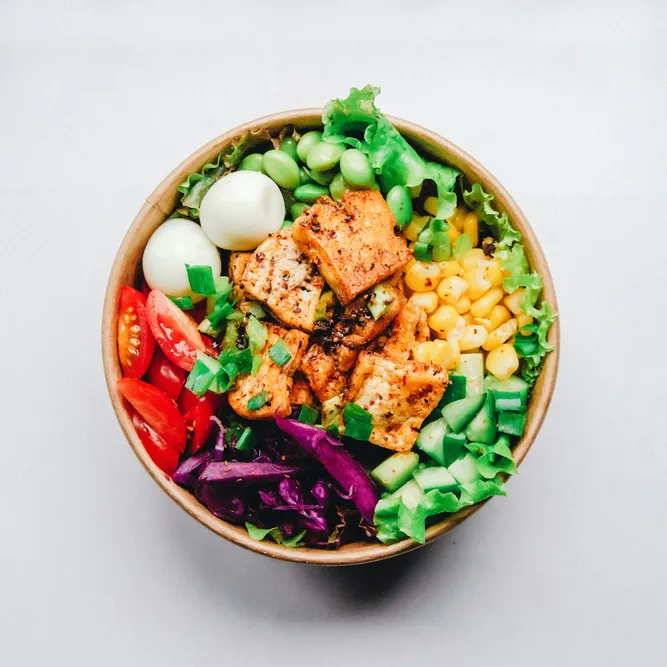
- Tofu and edamame bowl
- Tofu
- Edamame
- Rice or noodles
- Vegetables
- Sauce
- Leftover dinner
Calculate the portion from the original recipe and reserve enough food before serving dinner.
Avoid building lunch from sides
A lunch containing crackers, fruit, vegetables, and a small dip may include several nutritious foods but still provide relatively little protein.
| You can keep the foods and add: | Eggs | Yogurt |
|---|---|---|
| Cottage cheese | Tuna | Chicken |
| Tofu | Edamame | Beans |
| A sandwich filling | ||
A snack-style lunch can be substantial when every component has a role.
Dinner may not need more protein
Once breakfast and lunch improve, dinner can become more moderate.
| Suppose the original day was: | Breakfast: | 8 grams |
|---|---|---|
| Lunch: | 15 grams | Dinner: |
| 52 grams | Total: | 75 grams |
| A revised day might be: | Breakfast: | 22 grams |
| Lunch: | 25 grams | Dinner: |
| 28 grams | Total: | 75 grams |
The total has not changed.
Dinner can include a smaller protein portion without becoming nutritionally inadequate.
This may also create useful leftovers for breakfast or lunch.
Do not reduce dinner automatically
A high-protein dinner is not inherently a problem.
Keep it when:
You enjoy the meal.
The portion fits your energy needs.
You eat only two or three times a day.
Your daily target is high.
The meal follows training.
You have limited appetite earlier.
Your cultural eating pattern centers on a substantial evening meal.
The goal is not to make dinner small.
The goal is to avoid depending on dinner for almost everything when a more balanced pattern would fit your life.
Use snacks to close a real gap
A protein-rich snack can help when the target is difficult to reach through meals.
- For example:
- Breakfast:
- 25 grams
- Lunch:
- 30 grams
- Dinner:
- 35 grams
- Daily target:
- 105 grams
- The remaining gap is:
- 105 – 90 = 15 grams
A 15-gram snack can close it.
- Options may include:
- Yogurt
- Cottage cheese
- Eggs
- Edamame
- Milk or soy milk
- Cheese and another protein food
- Tuna and crackers
- A small sandwich
- A modest protein shake
Do not add a 30-gram shake when the actual gap is 10 to 15 grams unless it fits the wider day.
| Snacks do not need to match meals | A four-eating-occasion plan might look like: | Breakfast: |
|---|---|---|
| 25 grams | Lunch: | 30 grams |
| Snack: | 12 grams | Dinner: |
| 33 grams | Total: | 100 grams |
The snack is smaller because it serves a smaller role.
Even distribution does not mean every snack becomes a full meal.
What if you do not snack?
You can distribute protein across three meals.
- For a target of 90 grams:
- Breakfast:
- 25 grams
- Lunch:
- 30 grams
- Dinner:
- 35 grams
- For a target of 120 grams:
- Breakfast:
- 35 grams
- Lunch:
- 40 grams
- Dinner:
- 45 grams
Larger targets may create larger meals.
Decide whether those portions feel comfortable before assuming you need to eat only three times.
What if you eat only two meals?
Two meals can still provide the daily target.
- For 80 grams:
- First meal:
- 35 grams
- Second meal:
- 45 grams
- For 100 grams:
- First meal:
- 45 grams
- Second meal:
- 55 grams
This is less evenly distributed than a three-meal pattern but may fit your schedule.
Large doses are still digested and absorbed. Protein above 20 or 30 grams is not automatically wasted. The body uses absorbed amino acids for skeletal muscle and wider whole-body protein needs.
| Two meals may be less practical when: | Appetite is low | The target is high |
|---|---|---|
| Large meals cause digestive discomfort | You are an older adult struggling to eat enough | You train between the meals |
| Work prevents sufficient meal time | ||
A snack can reduce the size required at each main meal.
What if you eat five or six times?
Divide the total according to the size of each eating occasion.
- For a 120-gram target:
- Breakfast:
- 25 grams
- Snack:
- 15 grams
- Lunch:
- 30 grams
- Snack:
- 15 grams
- Dinner:
- 35 grams
You do not need 25 to 30 grams at all five occasions.
Frequent meals should not cause the daily total to rise far beyond the amount you intended.
How far apart should protein meals be?
Sports-nutrition guidance commonly discusses protein servings spaced approximately every three to four hours. This approach is intended to create repeated opportunities to stimulate muscle protein synthesis.
For everyday meal planning, ordinary gaps of roughly three to five hours are usually practical.
- You do not need to:
- Eat protein every two hours
- Set an alarm for the next meal
- Delay lunch because the exact interval has not passed
- Wake during the night to eat
- Carry a shake everywhere
Use natural meal spacing unless a medical or training plan requires something more specific.
Spread protein around exercise
Exercise changes the context, particularly resistance training.
A normal protein-rich meal before or after training may already support recovery.
- For example:
- Breakfast before training:
- 25 grams
- Lunch after training:
- 35 grams
- or:
- Lunch before training:
- 30 grams
- Dinner after training:
- 40 grams
You do not automatically need a shake when a complete meal is available within a practical period.
The NIH Office of Dietary Supplements emphasizes adequate daily protein for athletes, with needs commonly falling between approximately 1.2 and 2.0 grams per kilogram per day.
Do you need protein immediately after exercise?
No narrow universal window requires everyone to consume protein within a few minutes.
Resistance exercise increases the muscle’s sensitivity to protein for an extended period. Total daily intake and the wider distribution remain important.
A practical approach is to eat a protein-containing meal or snack near training when it fits naturally.
- For example:
- Breakfast after an early workout
- Lunch after a midday session
- Dinner after evening training
- A snack when the next full meal is several hours away
Do not add both a full meal and a large shake simply because the meal did not happen immediately.
A muscle-focused distribution model
A frequently cited muscle-building model uses approximately 0.4 grams of protein per kilogram per meal across at least four eating occasions.
This model is designed to reach approximately 1.6 grams per kilogram per day and maximize opportunities for muscle protein synthesis. It is not a universal health requirement.
- For a 60-kilogram person:
- 60 × 0.4 = 24 grams per meal
- Across four meals:
- 24 × 4 = 96 grams per day
- For an 80-kilogram person:
- 80 × 0.4 = 32 grams per meal
- Across four meals:
- 32 × 4 = 128 grams per day
- For a 100-kilogram person:
- 100 × 0.4 = 40 grams per meal
- Across four meals:
- 40 × 4 = 160 grams per day
Do not use this model before confirming that the resulting daily total suits your needs.
Older adults may benefit from stronger meals
Older adults may experience anabolic resistance, meaning that smaller protein doses can produce a weaker muscle protein synthesis response than they do in younger adults.
Research and expert reviews commonly discuss meal targets above 20 grams or approximately 0.4 grams per kilogram for older adults, although the best long-term distribution remains uncertain.
- For a 65-kilogram adult:
- 65 × 0.4 = 26 grams per meal
- For an 80-kilogram adult:
- 80 × 0.4 = 32 grams per meal
These are planning references, not compulsory prescriptions.
Health, kidney function, activity, appetite, chewing ability, body size, and total calorie intake still matter.
Make protein easier to eat when appetite is low
A large serving of meat may be difficult to finish.
Combine smaller foods.
- For example:
- Eggs
- + yogurt
- + toast
- Lentil soup
- + cheese or yogurt
- + bread
- Fish
- + peas
- + potatoes
- Chicken
- + beans
- + rice
- Oatmeal
- + milk
- + yogurt
The meal total can come from several protein sources.
Protein distribution during weight loss
A calorie deficit can make protein planning more important because the amount of food is lower.
Use a clear protein source at each main meal.
- A practical pattern might be:
- Breakfast:
- 20 to 30 grams
- Lunch:
- 25 to 35 grams
- Snack:
- 10 to 20 grams when needed
- Dinner:
- 25 to 40 grams
- Do not automatically remove:
- Protein
- Fruit
- Vegetables
- Beans
- Whole grains
when reducing calories.
Review oils, sauces, drinks, sweets, large grain portions, and multiple calorie-dense toppings separately.
Protein supplementation has been associated with small additional improvements in lean body mass and strength during resistance training, but total training, energy intake, and baseline protein remain important.
Protein distribution during weight gain
When trying to gain weight, do not let an extremely high protein target displace carbohydrate and fat.
- Once protein is sufficient, additional calories may come more comfortably from:
- Rice
- Pasta
- Bread
- Potatoes
- Oats
- Oils
- Nuts
- Seeds
- Avocado
- Dairy or alternatives
- Snacks
- Desserts and preferred foods
A high-calorie meal does not need to be built from an enormous lean protein portion.
Spreading plant protein
Plant-based meals can distribute protein effectively.
| Useful foods include: | Beans | Lentils |
|---|---|---|
| Chickpeas | Peas | Tofu |
| Tempeh | Edamame | Soy milk |
| Soy yogurt | Seitan | Nuts |
| Seeds | Whole grains | |
USDA recognizes beans, peas, lentils, nuts, seeds, eggs, seafood, meat, poultry, and soy foods within the Protein Foods Group and recommends using a variety of sources.
Plant-based meals may need larger portions or combinations to reach the same protein amount as a concentrated animal source.
Do plant proteins need to be combined at each meal?
Most healthy adults do not need to create a perfect complementary amino acid combination at every meal.
A varied eating pattern with enough total energy and protein can provide the necessary amino acids across the day.
- Natural combinations include:
- Beans and rice
- Lentils and bread
- Tofu and noodles
- Hummus and pita
- Peanut butter and bread
- Oats and soy milk
Use combinations for flavor, practicality, and nutrition rather than because every meal must complete an amino acid equation.
- A vegetarian distribution example
- Breakfast
- Yogurt or soy yogurt
- Oats
- Fruit
- Seeds
- Protein:
- Approximately 20 to 25 grams, depending on products
- Lunch
- Tofu and edamame bowl
- Rice
- Vegetables
- Sauce
- Protein:
- Approximately 25 to 35 grams
- Snack
- Cottage cheese, soy yogurt, or roasted chickpeas
- Fruit
- Protein:
- Approximately 10 to 20 grams
- Dinner
- Lentil pasta or curry
- Vegetables
- Yogurt, cheese, tofu, or beans
- Protein:
- Approximately 25 to 40 grams
Check the labels and actual serving sizes.
- A vegan distribution example
- Breakfast
- Tofu scramble
- Beans
- Whole-grain toast
- Vegetables
- Lunch
- Lentil and edamame grain bowl
- Snack
- Fortified soy drink
- Fruit
- Nuts or seeds
- Dinner
- Tempeh stir-fry
- Rice or noodles
- Vegetables
A vegan eating pattern also requires attention to nutrients beyond protein, including vitamin B12.
Approximate protein contributions
These are broad planning estimates. Product and food values vary, so use the Nutrition Facts label or USDA FoodData Central for specific calculations. FoodData Central is maintained by the USDA Agricultural Research Service and updated periodically.
| Food and practical portion | Approximate protein | Cooked chicken, turkey, fish, or lean meat, 3 to 4 oz |
|---|---|---|
| 20 to 32 g | Greek-style yogurt, 1 cup | 17 to 25 g |
| Cottage cheese, 1 cup | 24 to 28 g | Eggs, 2 large |
| 12 to 14 g | Cooked lentils, 1 cup | 16 to 18 g |
| Cooked beans or chickpeas, 1 cup | 13 to 16 g | Shelled edamame, 1 cup |
| 17 to 19 g | Firm tofu, 4 oz | 10 to 15 g |
| Milk or fortified soy milk, 1 cup | 7 to 9 g | Peanut butter, 2 tablespoons |
| 7 to 8 g | Nuts, 1 oz | 4 to 7 g |
| Protein powder, one serving | Check the label | |
Do not confuse MyPlate ounce-equivalents with grams of protein.
For example, one egg counts as one ounce-equivalent in the Protein Foods Group, but it does not contain one ounce or 28 grams of protein.
| Example of redistributing a 75-gram day | Original pattern | Eating occasion |
|---|---|---|
| Protein | Breakfast | 7 g |
| Lunch | 16 g | Snack |
| 2 g | Dinner | 50 g |
| Total | 75 g | Revised pattern |
| Eating occasion | Protein | Breakfast |
| 20 g | Lunch | 24 g |
| Snack | 6 g | Dinner |
| 25 g | Total | 75 g |
| Possible changes: | ||
Add yogurt to breakfast.
Add beans or more filling to lunch.
Use a milk-based drink or modest protein snack.
Reduce the oversized dinner protein portion.
No additional daily protein is required.
- Example of distributing 100 grams
- Breakfast
- Yogurt, oats, fruit, and seeds:
- 25 grams
- Lunch
- Chicken and bean bowl:
- 30 grams
- Snack
- Cottage cheese and fruit:
- 15 grams
- Dinner
- Fish, lentils, and potatoes:
- 30 grams
- Total
- 100 grams
- Example of distributing 120 grams
- Breakfast
- Eggs, yogurt, toast, and fruit:
- 30 grams
- Lunch
- Chicken and bean wrap meal:
- 35 grams
- Snack
- Protein-rich yogurt or shake:
- 20 grams
- Dinner
- Fish, tofu, or meat meal:
- 35 grams
- Total
- 120 grams
The correct target and portions depend on the individual.
- Example without a protein snack
- A 100-gram target can be distributed across three meals:
- Breakfast:
- 30 grams
- Lunch:
- 35 grams
- Dinner:
- 35 grams
This may be easier for someone who dislikes snacking.
It may be harder for someone with low morning appetite.
| Example with smaller meals | A 100-gram target can also be distributed across five occasions: | Breakfast: |
|---|---|---|
| 20 grams | Snack: | 15 grams |
| Lunch: | 25 grams | Snack: |
| 15 grams | Dinner: | 25 grams |
Use the pattern that feels more natural and sustainable.
Shift work and irregular schedules
Protein distribution should follow your waking period rather than conventional breakfast, lunch, and dinner labels.
- A night worker could use:
- Meal after waking:
- 25 grams
- Pre-shift meal:
- 30 grams
- Work meal:
- 30 grams
- Shift snack:
- 15 grams
The total is 100 grams.
Midnight does not need to reset the calculation.
Track the period from one main sleep to the next or use another consistent 24-hour window.
Low morning appetite
Do not force an enormous breakfast immediately after waking.
- Possible approaches include:
- Split breakfast
- After waking:
- Milk, soy milk, yogurt, or a small egg meal
- Later:
- Sandwich, oats, eggs, or another substantial meal
- Use a drinkable option
- Milk or soy milk
- Yogurt
- Fruit
- Oats
- Optional protein powder
- Shift more protein to lunch
- Breakfast:
- 15 to 20 grams
- Lunch:
- 30 to 40 grams
- Dinner:
- 30 to 40 grams
The pattern can remain reasonably distributed without making breakfast uncomfortable.
- Protein powder can fill a gap
- A supplement may be useful when:
- Breakfast remains too low despite practical food changes
- You need a portable option
- Your target is relatively high
- Appetite is limited
- Training and work reduce meal access
- A professional recommends it
Use it to fill a measured gap.
- For example:
- Breakfast protein:
- 16 grams
- Target:
- 25 grams
- Gap:
- 9 grams
You may need only part of a serving.
Do not add a full shake automatically.
Check the full meal, not only protein
Spreading protein should not push other foods out of the day.
| Every main meal still needs consideration of: | Carbohydrate | Fruit or vegetables |
|---|---|---|
| Fiber | Fat | Calories |
| Flavor | Satisfaction | Cultural preferences |
A protein-only breakfast may reach 30 grams while providing little fiber or carbohydrate.
A lunch containing only chicken and vegetables may be too low in energy for an active person.
Protein distribution is one part of meal structure.
- Do not remove carbohydrates
- Carbohydrate-rich foods can support:
- Energy
- Exercise
- Fiber
- Food variety
- Meal satisfaction
- Cultural dishes
- Useful options include:
- Rice
- Bread
- Pasta
- Potatoes
- Oats
- Fruit
- Beans
- Lentils
- Whole grains
- Tortillas
- Noodles
Pair them with protein rather than treating them as competition for plate space.
| Include fiber across the same meals | A protein-rich day can become low in fiber when it relies heavily on: | Meat |
|---|---|---|
| Fish | Eggs | Cheese |
| Protein powder | Low-fiber bars | |
Add fiber-rich foods at breakfast, lunch, snack time, and dinner.
- Examples include:
- Oats
- Fruit
- Vegetables
- Beans
- Lentils
- Whole grains
- Nuts
- Seeds
- Potatoes
This also supports the previous Phase 3 article on building a high-protein, high-fiber day.
Do not let protein numbers create unnecessary eating
Suppose dinner provides 27 grams and the target was 30.
You do not necessarily need to add food.
- Nutrition calculations contain uncertainty because of:
- Food size
- Cooking yield
- Brand differences
- Recipe portions
- Measuring error
- Database differences
A meal that falls a few grams below a planning target may still fit the daily range.
Use protein targets as guides rather than exact commands.
| Track a representative week, not every day forever | You can learn your distribution by tracking: | Two weekdays |
|---|---|---|
| One weekend day | One training day | One rest day |
Identify repeated patterns.
- For example:
- Breakfast:
- Usually 10 grams
- Lunch:
- Usually 20 grams
- Dinner:
- Usually 45 grams
Then create repeatable improvements.
- You may not need ongoing detailed tracking once you know:
- Your usual yogurt portion
- The chicken amount in a bowl
- The protein in your breakfast
- The recipe yield
- The amount in a regular snack
- Use a personal protein meal library
- Create categories such as:
- Breakfasts providing around 20 to 30 grams
- Yogurt, oats, and fruit
- Eggs, toast, and yogurt
- Tofu scramble and beans
- Breakfast wrap
- Protein oatmeal
- Lunches providing around 25 to 35 grams
- Chicken and bean bowl
- Tuna sandwich and yogurt
- Lentil soup with eggs or dairy
- Tofu and edamame bowl
- Leftover dinner
- Dinners providing around 25 to 40 grams
- Fish and lentils
- Chicken curry
- Bean chili with yogurt or cheese
- Tofu and edamame stir-fry
- Meat or lentil pasta sauce
- Snacks providing around 10 to 20 grams
- Yogurt
- Cottage cheese
- Eggs
- Soy milk
- Edamame
- Small sandwich
- Protein shake
This makes distribution easier without recalculating every meal.
- Common mistakes
- Focusing on distribution before the daily total
Meet an appropriate daily amount first.
Treating even distribution as exact equality
Reasonably balanced meals are enough.
Assuming the same per-meal target fits every person
Body weight, age, activity, health, and meal frequency differ.
Saving most protein for dinner
Strengthen breakfast and lunch when practical.
Adding protein without moving any from dinner
You may raise the daily total unnecessarily.
Forcing a large breakfast despite low appetite
Split the meal or use a smaller protein source.
Treating one egg as a complete protein anchor
Consider the full meal target.
Assuming nuts are a highly concentrated protein food
They provide protein, but normal portions may contribute fewer grams than expected.
Adding a full shake for a small gap
Calculate what the day actually needs.
Eating protein every two hours
Normal meal spacing is usually sufficient.
Believing protein above 30 grams is wasted
The body absorbs and uses protein beyond that amount.
Ignoring total calories
Additional protein food still contributes energy.
Removing carbohydrates
Protein distribution does not require a low-carbohydrate diet.
Forgetting fiber
Meat, fish, eggs, dairy, and protein powders may contain little or no fiber.
Using only one protein source
Include varied animal or plant proteins according to your preferences.
Confusing food-group equivalents with protein grams
MyPlate ounce-equivalents are not the same as grams of protein nutrient.
Treating acute muscle protein synthesis as guaranteed muscle gain
Long-term outcomes depend on total intake, resistance training, energy, recovery, and consistency.
Applying athletic targets to everyone
Performance-focused ranges may be higher than general adult needs.
Following a high-protein pattern with kidney disease without guidance
Protein requirements may need medical adjustment.
Protein distribution and kidney disease
People with chronic kidney disease may need a different daily protein amount.
Some people with kidney disease are advised to moderate protein, while people receiving dialysis may have different requirements. NIDDK recommends working with the healthcare professional or renal dietitian managing the condition.
Do not begin by distributing a high target across meals when the target itself may be inappropriate.
- Other situations requiring individualized guidance
- Seek qualified advice when you:
- Are pregnant or breastfeeding
- Are under 18
- Have kidney or liver disease
- Have an inherited metabolic condition
- Are recovering from major illness, surgery, or injury
- Have difficulty chewing or swallowing
- Have an eating disorder or history of disordered eating
- Have unexplained weight or muscle loss
- Need medically supervised weight change
- Follow a highly restricted diet
- Need specialized sports nutrition
The correct amount and timing may differ from general examples.
Frequently asked questions
Should protein be spread evenly throughout the day?
A reasonably distributed pattern can help you meet your target and may improve the short-term muscle protein synthesis response compared with eating most protein at dinner. Long-term benefits from perfectly equal distribution remain uncertain.
Does every meal need the same protein amount?
No. A day containing 25, 30, and 35 grams is reasonably distributed even though the meals are not identical.
What is the best protein distribution?
Begin with your daily target, divide it across your normal eating occasions, and adjust the result to your appetite and schedule.
Is 30 grams at every meal necessary?
No. It may be practical for someone targeting about 90 grams across three meals, but other targets require different amounts.
Is 20 grams at breakfast enough?
It can be, especially when lunch and dinner provide more. Compare the full daily total with your needs.
Can I eat 40 grams of protein at dinner?
Yes. Forty grams is not automatically excessive or wasted. It may fit a higher target, larger body size, training schedule, or two-meal pattern.
Is protein over 30 grams wasted?
No. The body digests and absorbs more than 30 grams. Not all absorbed amino acids are used for muscle protein synthesis at the same moment.
Is total protein more important than timing?
Current reviews generally identify total daily protein as the more important factor for lean body mass, with distribution serving as a secondary consideration.
How do I calculate protein per meal?
Use:
Should snacks contain protein?
Only when they help close a genuine gap, support your schedule, or fit your appetite.
How many protein meals should I eat?
Three to five protein-containing eating occasions work for many people, but two or more than five can also work when they fit the daily total and individual needs.
How long should I wait between protein meals?
Sports guidance often discusses spacing protein about three to four hours apart. Ordinary meal timing is sufficient for most people, and you do not need an exact timer.
Do I need protein immediately after exercise?
No. A normal protein-rich meal before or after training may be enough. Total daily intake and the wider pattern matter.
Should I have protein before bed?
It is optional. It may help particular training or muscle-maintenance plans, but it is unnecessary when the daily target is already met or late food affects comfort.
How should older adults spread protein?
Research-based proposals often suggest stronger protein portions at each main meal, sometimes around 0.4 grams per kilogram, but health, appetite, kidney function, and total needs require individual consideration.
Can I spread protein evenly on a vegetarian diet?
Yes. Use foods such as beans, lentils, tofu, tempeh, edamame, eggs, dairy, soy milk, nuts, seeds, and suitable grains.
Do plant proteins count?
Yes. They contribute to the daily and meal totals.
Do plant proteins need to be paired at every meal?
Usually not. A varied eating pattern with adequate protein and energy can provide the required amino acids across the day.
Do I need protein powder?
No. It is optional and is most useful when it fills a real gap or provides meaningful convenience.
Can I distribute protein across two meals?
Yes, although each meal may need to contain a larger amount. Add a snack when the portions become uncomfortable.
How do I improve a low-protein breakfast?
Add eggs, yogurt, cottage cheese, milk, soy milk, tofu, beans, chicken, fish, or a measured protein supplement.
How do I improve a low-protein lunch?
Add a clear protein anchor such as chicken, tuna, eggs, tofu, beans, lentils, yogurt, cottage cheese, or edamame.
Should I reduce dinner protein?
Only when moving some of it earlier improves your overall plan. A high-protein dinner can still fit.
Does evenly spreading protein build more muscle?
It may improve the acute muscle protein synthesis response, but longer trials have not consistently found greater muscle mass or strength from distribution alone. Resistance training and adequate daily protein remain central.
Should people with kidney disease spread protein evenly?
The first question is how much protein is medically appropriate. Follow guidance from the healthcare professional or renal dietitian managing the condition.
Daily protein target
÷ number of protein-containing eating occasions
Then use the result as a range.
Spread protein reasonably, not perfectly
Start with the daily amount.
Then count the meals and protein-rich snacks you genuinely eat. Divide the target into practical ranges and compare those ranges with your current meals.
Most people do not need to rebuild dinner. They need to strengthen breakfast, lunch, or both.
Add yogurt to oats. Add eggs to toast. Put enough filling in the sandwich. Add beans to the bowl. Use a measured snack when the daily total still has a gap.
Do not force identical numbers.
A day containing 25 grams at breakfast, 30 grams at lunch, and 35 grams at dinner is already reasonably distributed.
Research suggests that spreading protein can improve the short-term muscle-building response compared with a strongly dinner-heavy pattern. However, longer studies do not consistently show that perfect distribution produces more muscle or strength when the daily total is already sufficient.
That makes the practical conclusion straightforward:
Meet an appropriate daily protein target. Avoid leaving nearly all of it until dinner. Spread it across meals in a way that fits your appetite, routine, training, health, and food preferences.